


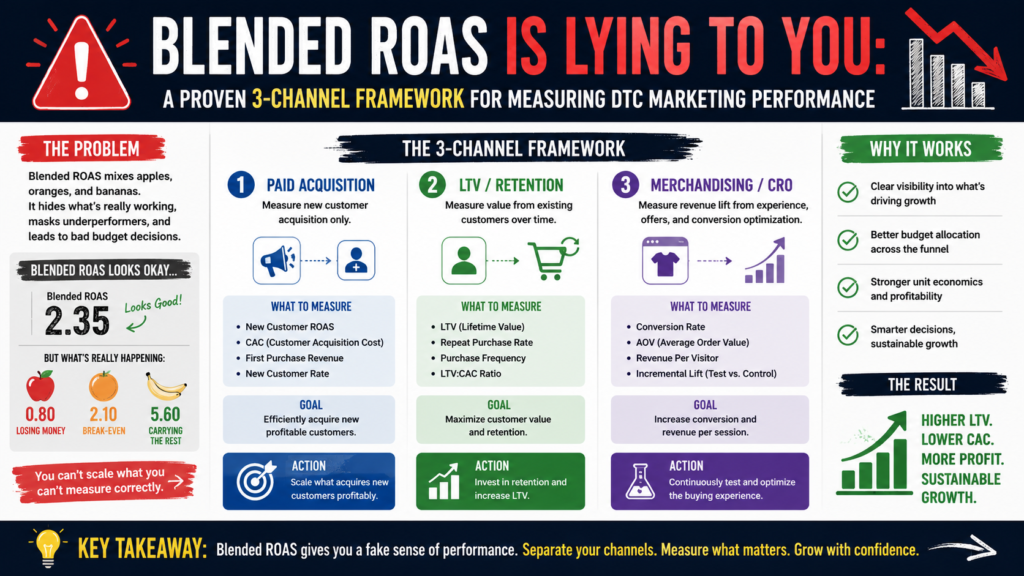
Your blended ROAS looks fine. That is the problem.
A single blended number averages every channel into one comfortable figure, and that average hides the two things you actually need to know: which channel is creating demand, and which one is taking credit for sales it never caused. The cost of getting this wrong is not theoretical. Research from Commerce Signals found that roughly 47% of marketing spend is wasted, much of it traced to fragmented data and broken attribution. The Association of National Advertisers puts waste in programmatic media alone at $26.8 billion, up 34% in just two years. A large share of that loss is not bad advertising. It is good advertising measured with a bad number.
When you run all of your paid media through one ROAS line, a branded search campaign that converts people who were already going to buy looks identical to a prospecting campaign that found a brand new customer. They are not the same. Treating them the same is how DTC brands pour budget into the channels that report well and starve the ones that actually grow the business.
Performance marketing is supposed to be the discipline that fixes this. Done properly, it does. The problem is that most DTC brands measure performance marketing with the bluntest tool available, then make six-figure performance marketing budget decisions on top of a number that was never built to carry that weight. It shows in the results. According to HubSpot, only 40% of marketers can say with confidence which channels actually drive their revenue.
This is the proven performance marketing framework we use to measure DTC marketing performance channel by channel, so your numbers tell you the truth instead of flattering you.
Why Blended ROAS Lies to Performance Marketing Teams
Blended ROAS is total revenue divided by total ad spend. It is easy to calculate and easy to report, which is exactly why it survives in so many dashboards. It is also close to useless for the performance marketing decisions that matter, like where the next dollar of spend should go.
Here is the mechanism. Blended ROAS treats every channel as interchangeable. Your Amazon advertising, your Meta ads, your Google Ads, and your branded search all dump into one pool. The number that comes out tells you the average return across all of them, and an average is precisely what you do not want when the channels behave nothing alike. One strong channel can mask three weak ones. One channel quietly harvesting existing demand can inflate the whole figure while contributing almost no incremental growth.
This matters more every year, because acquisition keeps getting more expensive. Average ecommerce customer acquisition cost climbed 40% to 60% between 2023 and 2025, landing somewhere around $68 to $84 per customer, and Shopify’s 2026 Global Commerce Report shows blended CAC rising from $274 to $318 in a single year. Google Shopping cost per click jumped almost 34% in 2025 while Meta CPMs hit record highs. When every customer costs more, a measurement error costs more too.
Last-click attribution has the opposite failure but lands you in the same place. It hands all the credit to the final touch before purchase, which is almost always branded search or retargeting, the two channels that convert people who were already sold. Your prospecting, the real top of funnel work that introduced the customer, gets zero. So you cut it. Then you wonder why your customer acquisition cost climbs and new customer growth stalls. Weak marketing attribution does not just misreport the past, it actively steers you toward the wrong future.
Both methods fail for the same underlying reason. They refuse to separate channels by the job each one is doing.
The Performance Marketing Framework: Separate the Job, Then Measure It
Every paid channel in a DTC account is doing one of three jobs. Prospecting finds people who do not know you. Retargeting converts people who visited but did not buy. Branded and demand-capture harvests people already searching for you by name. The entire point of real performance marketing measurement is to score each job on its own terms, because each job has a completely different expected return, and lumping them into one line is the original sin of weak performance marketing.
Here is how that plays out across the three channels where most DTC budget actually lives.
Meta Ads: Split Prospecting From Retargeting
Stop reading Meta as one number. Inside your performance marketing account, prospecting campaigns and retargeting campaigns belong in separate reports with separate targets.
Retargeting will almost always show a gorgeous ROAS, because it is converting warm traffic you already paid to acquire. That high number is not skill, it is selection. Prospecting will show a lower ROAS, because it is doing the hard and valuable work of finding strangers. If you judge your Meta ads against a single benchmark, you will kill the channel that grows you and over-invest in the one that just collects. Track new customer ROAS for prospecting and a separate efficiency target for retargeting.
Google Ads: Branded Search Versus Real Demand
The single most common way DTC brands fool themselves is branded search. It posts a spectacular ROAS, and that ROAS is mostly fiction, because most of those buyers would have found you anyway by typing your name.
This is not opinion, it is one of the most replicated findings in marketing science. In a landmark field experiment, economists working with eBay switched off branded search ads and found that traffic and sales stayed virtually flat, because organic listings absorbed nearly all of the clicks the ads used to buy. A later replication at Edmunds found the same substitution effect, though smaller, with less than half of the paid traffic recovered for a less dominant brand.
The lesson is not that branded search is always worthless. It is that the platform-reported ROAS on branded search is almost never the incremental truth. Pull branded out of your blended Google number and look at it alone. Then look at non-brand search and shopping separately inside Google Ads, because those are the campaigns actually capturing new demand rather than collecting it.
Amazon Advertising: Credit It Deserves Versus Credit It Takes
Amazon advertising is its own measurement trap. Amazon ads frequently get credit for organic sales that would have happened regardless of the placement, because shoppers on Amazon arrive with high purchase intent before they ever see your sponsored listing. Read Amazon advertising through total advertising cost of sale and new-to-brand metrics, not just the in-platform ROAS that the channel reports about itself.
Read Incrementality, Not Last-Click Attribution
Here is the question every one of these channels should be forced to answer: if you turned this campaign off tomorrow, how many of these sales would still happen?
That is incrementality, and it is the only honest measure of whether a channel is creating value or claiming it. Branded search and retargeting tend to score badly on incrementality because much of their reported revenue would arrive without them. Prospecting and non-brand demand generation score well because they genuinely produce sales that would not otherwise exist. Incrementality also cuts both ways, which is the point. Google’s own research has found that a large majority of paid search clicks can be incremental in the right context, so the answer is never to assume, it is to test.
You do not need a perfect data science setup to start. Geo holdout tests, where you pause a channel in some regions and compare against matched regions where it stays live, give you a real read on incremental lift. Even simple on-off testing over clean time windows beats trusting last-click.
Forrester estimates that moving to unified, incrementality-based measurement improves marketing budget efficiency by 15% to 20%, and analysis of programmatic spend suggests that reallocating even 5% to 10% of budget toward proven incremental tactics can reclaim millions. This is the line between marketing analytics that describe what happened and marketing analytics that tell you what to do next, and it is where serious performance marketing actually lives.
The Performance Marketing Metrics That Actually Predict Growth
Once you measure channel by channel, a better performance marketing scorecard replaces blended ROAS. Track these instead.
New customer ROAS measures the cost of acquiring customers rather than reconverting them, while customer acquisition cost (CAC) by channel identifies profitable versus expensive sources. Many DTC brands underestimate their true CAC by 20% to 40% by only considering ad spend without factoring in returns, fees, and creative costs. Incremental ROAS attributes sales to the campaigns that generated them, and calculating contribution margin after ad spend is crucial since revenue alone is misleading without accounting for product costs and media expenses. With US retail returns expected to reach $890 billion in 2024, brands focusing solely on revenue rather than margin are misrepresenting their performance.
These are the performance marketing numbers that move with reality. Blended ROAS moves with your channel mix, which is why it can climb while your business quietly gets weaker. It is no accident that the 2025 State of DTC Marketing Report found brands shifting their primary KPIs away from raw visibility and toward profitability measures like customer acquisition cost, lifetime value, and contribution margin.
Performance Marketing Measurement Is the Work, and It Compounds
Measuring DTC marketing performance properly is not a one-time audit. It is the operating system for every performance marketing budget decision you make. Get it right and your spend flows toward the channels that grow you, your customer acquisition cost stabilizes, and your ecommerce marketing finally has a feedback loop you can trust. Get it wrong and you will keep optimizing toward a number designed to make you feel good while it costs you the growth you are paying for. The brands that win do not simply spend more, they measure better, and that edge compounds every quarter the gap goes unclosed.
At Treszon, this is how we run performance marketing for the brands we work with. We separate every channel by the job it does, measure incrementality instead of last-click, and manage paid media against the metrics that actually predict growth, because we operate every account like we own it. A performance marketing agency that hands you a blended ROAS report and calls it insight is not measuring your business, it is decorating it. If your blended ROAS looks healthy and your growth does not feel like it, that gap is exactly what we fix.
Ready to see what your channels are really doing? Let’s talk.