

You launched a great product. The photos are clean, the price is competitive, and you’re proud of the listing. Then weeks pass, and the sales just aren’t coming. You search for your own product and scroll, and scroll, and still cannot find it. Meanwhile, a competitor with a worse product sits right at the top.
This is the single most common frustration for new sellers, and the cause is almost always the same. Your listing is invisible to the one system that decides who gets seen: Amazon’s search engine. Fixing that is what Amazon SEO is all about, and once you understand how it works, the problem stops feeling like bad luck and starts looking like something you can actually solve.
Amazon SEO Meaning
Amazon SEO is the practice of optimizing your product listings so they rank higher in Amazon’s search results. When a shopper types a query into that search bar, Amazon’s algorithm decides which products to show first, and Amazon SEO is how you earn one of those top spots.
If you’ve heard of Google SEO, the idea is similar, but the goal is different. Google wants to give people information. Amazon wants to make a sale. That single distinction shapes everything about how amazon seo works, because Amazon’s algorithm is built to surface the products most likely to convert a search into a purchase.
Here’s why this is not optional. Amazon is no longer just a store, it is one of the largest product search engines. Recent industry research shows that around 56% of all online product searches now begin on Amazon, ahead of traditional search engines. When people are ready to buy, Amazon is where they look first. If your listing does not appear there, you are missing customers.
Why Nobody Can Find Your Products
The majority of Amazon shoppers never scroll past the first page, and the top few results capture the lion’s share of all clicks. If your listing sits on page five, it might as well be invisible. Great products fail every day not because of quality, but because nobody ever sees them.
So why does this happen to listings that seem perfectly good? A few reasons come up again and again.
- Your title and bullets are missing the words shoppers actually type. If a buyer searches “stainless steel water bottle” and your title only says “premium hydration companion,” Amazon has nothing to match you against. The algorithm cannot rank you for terms you never used.
- Your backend keywords are empty or wasted. Amazon gives you a hidden search-terms field that most sellers ignore or fill with repeated words, throwing away free ranking opportunities.
- Your listing isn’t converting. Amazon watches how shoppers behave. If people click your listing but don’t buy, the algorithm reads that as a weak result and quietly pushes you down. Poor images, thin copy, and few reviews all feed this cycle.
- You’re targeting the wrong terms. Sometimes a listing ranks well for keywords nobody searches, and never appears for the ones that drive real sales.
How Amazon Decides What to Show: The Five Pieces
To fix your visibility, it helps to see the search experience the way Amazon does. The path from a shopper’s query to a purchase runs through five connected pieces, and your listing has to earn its place at each one.
It starts with the search box, where a customer types a word or phrase. From there, filters let them narrow by price, reviews, delivery speed, and more, so a listing that misses on those fronts gets filtered out before it is ever seen. Next is the search results page, where your product competes head to head with rivals on title, image, price, and rating. Behind all of this sits sales rank, Amazon’s real-time measure of how well a product is selling within its category, which both reflects and reinforces visibility. Finally, Sponsored Products and other ads let listings appear in prominent spots, which is why paid and organic strategy work best together.
Understanding these five pieces reframes the whole problem. Ranking is not a single lever. It is the collective result of showing up, getting clicked, and converting, again and again.
The Algorithm Has Quietly Changed
For years, Amazon’s ranking system was known as A9, and it leaned heavily on exact keyword matches and raw sales velocity. That era rewarded sellers who crammed keywords into titles and chased quick sales spikes. Around 2020 and 2021, Amazon evolved the system into what the industry now calls A10, and the shift matters for how you approach amazon seo today.
A10 pays far more attention to shopper behavior and listing quality than to keyword stuffing alone. The factors that move the needle now include keyword relevance, click-through rate, conversion rate, organic sales velocity (weighted more heavily than ad-driven sales), seller performance metrics like order defect and late shipment rates, external traffic you drive from outside Amazon, competitive pricing, and the depth and quality of your reviews. In plain terms, the algorithm rewards listings that real shoppers genuinely want and that real sellers reliably deliver.
The Core of How Amazon SEO Works
Understanding how to do amazon seo starts with knowing what the algorithm actually rewards. Two things matter most: relevance and performance.
Relevance is about matching. Amazon needs to understand exactly what your product is and which searches it belongs in, and it learns that from the text in your listing. That means your title, bullet points, description, and backend search terms all need to carry the keywords your customers use.
Performance is about proof. Once Amazon shows your listing, it measures the response. Click-through rate, conversion rate, and sales velocity tell the algorithm whether shoppers actually want what you’re offering. Strong performance pushes you up; weak performance pulls you down. This is the heart of how to do seo for amazon products, and it’s why keyword stuffing alone never works. You need the right words and a listing that converts.
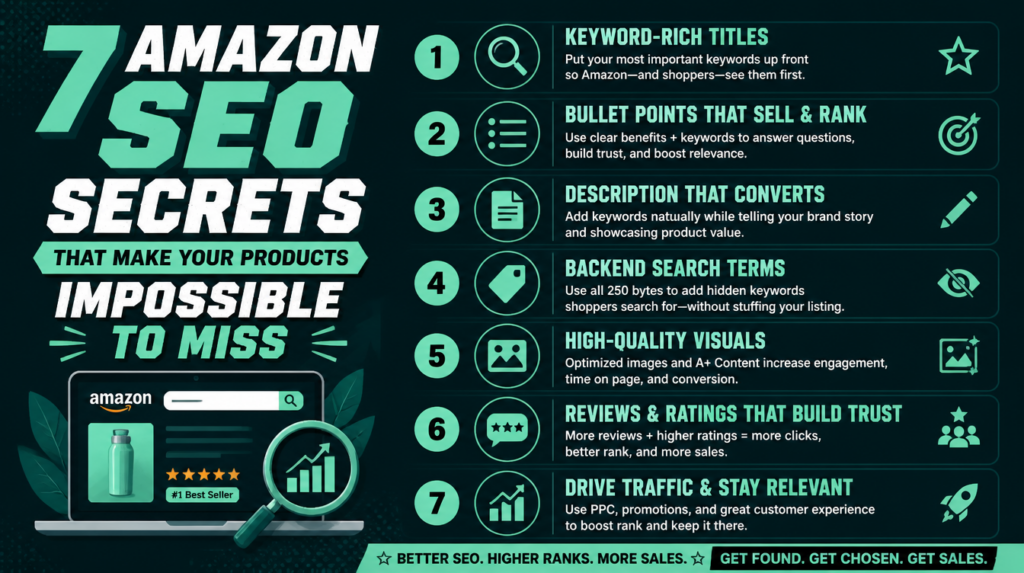
The 7 Secrets That Make Your Products Impossible to Miss
A real amazon seo strategy is not a one-time task, it is a repeatable system. These are the seven moves that do the heavy lifting, the same ones that separate the listings buyers find from the listings that vanish. Work through them in order.
1. Start With the Keywords Your Buyers Actually Type
Find the exact phrases real shoppers enter, and mix broad short-tail terms that carry high volume with specific long-tail searches that convert better because the intent is clearer. A dedicated amazon seo keyword tool surfaces the terms your competitors rank for and the demand behind them, and there are solid options at every budget.
2. Lead Your Title With Your Strongest Keyword
Your title carries more ranking weight than any other field, so the move here is placement, not repetition. Put your single most important keyword near the front, where both Amazon and the shopper grasp instantly what you are selling.
Amazon can parse keywords even when they are not next to each other, so you never need to repeat a word to rank for it. Keep the title clean and readable, and front-load the part that matters, since long titles get cut off on smaller screens.
3. Fix Your Hidden Backend Search Terms
Most categories give you a backend Search Terms field of roughly 250 bytes that customers never see but Amazon still indexes. This is free ranking real estate, and skipping it is one of the most common ways sellers stay invisible. Fill it with synonyms, alternate spellings, and abbreviations that did not fit naturally up front. Use all lowercase, separate words with single spaces instead of commas, avoid repeating words already in your title, and leave out brand names you do not own.
4. Win the Click With Your Main Image
Ranking gets you seen, but your main image is what makes a shopper stop scrolling and click. Keep it on a pure white background, let the product fill at least 85% of the frame, and make it sharp enough to stay clear when zoomed at 1,000 pixels or more. Then use every image slot Amazon gives you, adding lifestyle shots that show the product in use and infographics that highlight key features. A weak main image quietly caps how far any other optimization can take you.
5. Write Bullets That Sell, Not Just List
Your bullet points are indexed for keywords and read by shoppers, so they have to do double duty. Lead each one with a clear benefit, then explain why the feature matters rather than just naming it. “Stainless steel construction” means little on its own, but “stainless steel construction that resists rust and keeps drinks odor-free” gives a buyer a reason to choose you. Weave in the supporting keywords that did not fit your title, using natural variations instead of repeating the same phrase.
6. Turn Reviews and Q&A Into Free Keywords
Reviews are not only social proof, they are a ranking signal. A listing with hundreds of strong reviews consistently outranks one with a handful, because Amazon reads that track record as a safer bet to convert. Better still, the algorithm parses the language inside reviews and your Q&A section, so when customers naturally mention features like “leakproof lid” or “fits a cup holder,” your listing can start surfacing for those long-tail searches without you adding a single keyword. Encourage feedback after purchase, keep your Q&A answered, and fix the product when several reviews flag the same issue.
7. Protect Your Ranking Momentum
The first six moves win visibility, this one keeps it. Price competitively, because strong sales velocity feeds your ranking, and an overpriced listing that does not justify the premium will stall. Guard your inventory just as closely, since running out of stock can wipe out the momentum you built and force you to climb back from scratch. Then treat the whole system as ongoing: watch your rankings and sales, see what moves, and keep refining. The sellers who win do this continuously, not once.
Tools and Help to Get You Started
You don’t have to do all of this blind. A good amazon seo tool can reveal which keywords your competitors rank for, track your own positions over time, and surface opportunities you’d never spot manually. If you’re on a budget, start by exploring amazon seo tools free options, including Amazon’s own Product Opportunity Explorer and, for brand-registered sellers, Brand Analytics, both built on Amazon’s first-party search data.
If you’d rather build real expertise, an amazon seo course can teach you the fundamentals end to end. And when the stakes are high or your time is short, bringing in an amazon seo consultant or a dedicated amazon seo specialist can compress months of trial and error into a focused, results-driven plan.
Mistakes That Keep You Invisible
A handful of avoidable errors sink more listings than anything else. Keyword stuffing makes your title unreadable and signals spam. Chasing high-volume keywords that don’t match your product invites clicks that never convert, which teaches the algorithm you’re irrelevant. Leaving the backend field empty wastes free ranking real estate. Never updating a listing lets it drift as search terms evolve. Weak images cost you both clicks and conversions. Violating Amazon’s content rules, such as banned phrases or all-caps titles, risks suppression. And running out of stock can erase your ranking momentum entirely, forcing you to rebuild from scratch.
Amazon SEO in 2026 and Beyond
The principles above are durable, but the details keep shifting. The most important change shaping amazon seo 2026 is the growing role of AI in how shoppers discover products. Search is becoming more conversational, listings are increasingly read and ranked by machine systems before a human ever sees them, and clean, well-structured product data matters more than ever. Discovery is also spreading beyond Amazon itself, with younger shoppers starting product searches on platforms like TikTok, which makes the external traffic you drive to your listings more valuable than before. The sellers who keep their listings accurate, keyword-rich, and genuinely useful are the ones who will stay visible as the platform evolves.
Stop Being Invisible on Amazon
Your product deserves to be found. Right now, the only thing standing between your listing and the customers searching for it is a search engine you haven’t yet learned to speak to. The good news is that none of these seven moves is out of reach, and every improvement you make compounds into more visibility and more sales.
At Treszon, this is exactly what we do. Our team optimizes listings to rank, convert, and climb, turning invisible products into ones shoppers actually find. If you’re tired of watching weaker competitors outrank you, let’s fix that. Contact Treszon today for an Amazon SEO review, and put your products where buyers can finally see them.