

There is a shift happening in ecommerce that most brands have not fully priced in yet. The way customers discover and buy products is moving away from search boxes and browser tabs and toward AI agents that research, compare, and purchase on a shopper’s behalf. If your products are not structured for machines to read, you are about to become invisible to the fastest-growing channel in retail. This is the rise of agentic commerce, and it is arriving faster than most brands realize.
This is not a prediction about the distant future. It is already measurable in revenue, and the brands that adapt early are pulling ahead of the ones that wait. Invisibility is the real risk here, because when an AI agent does the shopping, a product it cannot read or does not select simply never reaches the customer. This guide breaks down what agentic commerce actually is, why the data makes it impossible to ignore, what Shopify’s latest release tells you about where the industry is heading, and, most importantly, the seven concrete moves you can make right now to stay visible and get chosen.
What Agentic Commerce Actually Means
Agentic commerce is shopping done by autonomous AI agents. Instead of typing a query into Google, scrolling through ten blue links, opening five tabs, and comparing products yourself, you ask an AI assistant something like “find me a waterproof jacket for a weekend hiking trip under 150 dollars” and the agent does the work. It searches, reads product data, compares options against your criteria, narrows the field to a recommendation, and in a growing number of cases completes the purchase without you ever visiting a traditional storefront. That is agentic commerce in practice.
The important word is agent. A search engine returns a list and leaves the choosing to the human. An agent pre-qualifies, compresses the funnel, and hands back a single answer. That changes the game completely. In the old model, showing up on page one was enough to get a click. In the new model, if the agent does not select your product, the shopper may never even know it existed. There is no page two to fall back on. There is one recommendation, and in agentic commerce, being that recommendation is the entire game.
This is why people in the industry have started calling the new discipline Generative Engine Optimization, or Answer Engine Optimization. It is the successor to SEO in the age of agentic commerce, and the rules are different.
Why the Agentic Commerce Data Is Impossible to Ignore
If this still sounds like hype, the numbers say otherwise. Adobe, which tracks more than one trillion visits to US retail sites, reported that AI-driven traffic to those sites grew 393 percent year over year in the first quarter of 2026, continuing a holiday season when AI traffic surged 693 percent. That growth alone would be worth paying attention to, but the more important shift is what happens after the click.
In March 2026, AI-referred traffic converted 42 percent better than non-AI traffic like paid search and email. That is a record in Adobe’s data, and it is a complete reversal from a year earlier, when AI traffic converted 38 percent worse. In twelve months, the conversion relationship flipped by roughly 80 percentage points. AI-referred shoppers also spend about 48 percent longer on site, browse more pages, and generate 37 percent more revenue per visit than everyone else. The reason is the core mechanic of agentic commerce: by the time an agent sends a shopper to your product, it has already pre-qualified them. The intent is higher because the filtering happened upstream.
The macro picture is just as clear. Salesforce found that AI and agents influenced roughly 20 percent of global online orders during the 2025 holiday season, about 262 billion dollars in sales. McKinsey projects agentic commerce could orchestrate up to one trillion dollars in US retail revenue by 2030. And the single most actionable statistic for operators comes from Salesforce as well: retailers that ran their own branded shopping agents grew holiday sales 59 percent faster than those that did not, 6.2 percent against 3.9 percent.
The catch is that most stores are not ready. Adobe’s audit of the retail sector scored the average product detail page at just 66 percent on machine readability, with roughly a quarter of homepage content invisible to large language models. The demand is arriving faster than the supply of stores prepared to capture it. That agentic commerce gap is the opportunity for the brands that move first.
Shopify’s Spring 2026 Edition Is the Agentic Commerce Blueprint
The clearest signal of where this is all heading came from Shopify’s Spring 2026 Edition, which reorganized the platform around agentic commerce. Even if you do not sell on Shopify, it is worth understanding, because it shows what agentic commerce readiness looks like when a major platform builds it in by default.
Two pieces of infrastructure sit at the center. The first is Shopify Catalog, a structured, global dataset of product information that AI agents can search and understand. It syndicates product details to ChatGPT, Copilot, the Shop app, and other surfaces automatically, with no extra apps and no manual feeds. The payoff is the number every operator should remember: AI searches powered by clean, structured Catalog data convert at twice the rate of searches built on scraped data. Structured beats scraped, and the difference shows up directly in conversion.
The second piece is the Universal Commerce Protocol, co-developed by Shopify and Google and launched in January 2026, endorsed by more than 20 retailers including Home Depot, Lowe’s, Best Buy, Macy’s, Visa, and Mastercard. A protocol is just a shared language, in this case the language agents use to interact with merchants across the full journey from discovery to checkout. It is not the only one. OpenAI and Stripe shipped a competing standard, the Agentic Commerce Protocol, in September 2025. Merchants that support multiple protocols see roughly 40 percent more agentic traffic, so protocol coverage is becoming its own form of distribution.
Shopify also gave merchants a command center. The new Agentic Storefronts dashboard pulls orders, sales, and conversions from ChatGPT, Copilot, AI Mode in Google Search, the Gemini app, and Shop into one view, shows which AI queries a store ranks for and which it misses, and flags products that surface in AI conversations but fail to convert. Early results are real: one brand saw AI channels drive 3.2 percent of total revenue in a single month, and another reported revenue from AI channels up 20 times year over year.
The takeaway is not that you need Shopify. It is that the requirements Shopify just built in, structured product data, protocol coverage, and channel visibility, are becoming the baseline everywhere agentic commerce reaches, including on Amazon and every other surface where agents shop.
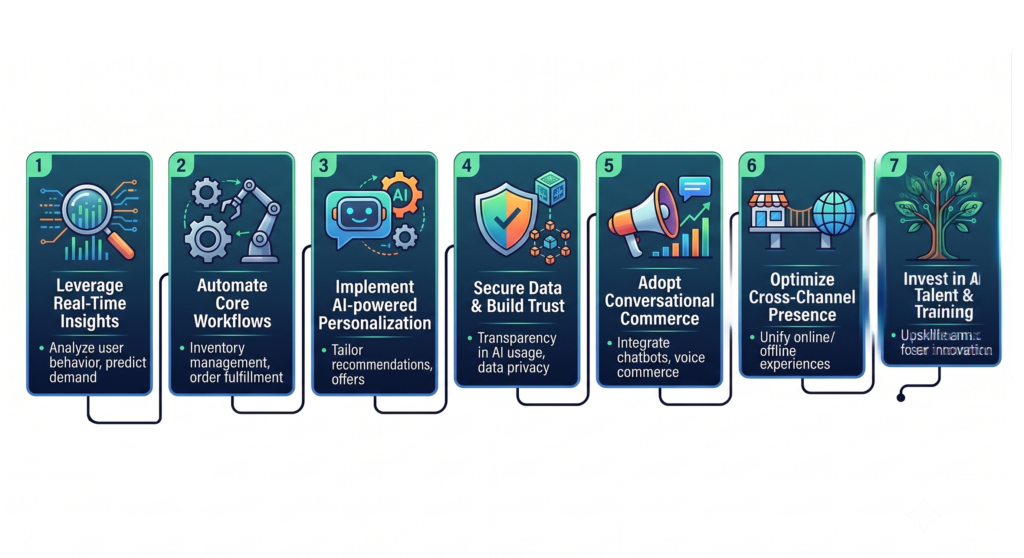
The 7 Moves That Keep You Visible to AI
Understanding the shift is the easy part. Here are the seven agentic commerce moves that keep your products readable, recommendable, and buyable by agents, and none of them require waiting for a platform to hand them to you. Work through them in order. Each one closes a gap that would otherwise make your store invisible at the exact moment an agent is deciding what to recommend.
Move 1: Structure Your Product Data for Machines
The foundation of agentic commerce is clean, structured, machine-readable product data. Agents cannot recommend what they cannot parse. Implement Product schema markup using JSON-LD on every product page, including price, availability, brand, GTIN or SKU, and review ratings. This is the format search engines and language models read most reliably. If your product data lives only in prose or in images, it is effectively invisible. The goal is for a machine to extract your title, price, options, and availability without guessing.
Move 2: Fill In Every Attribute, Completely
Agents match products to specific, detailed queries. A shopper asking for a “waterproof jacket for a weekend hiking trip under 150 dollars” is filtering on material, use case, waterproofing, and price at once. If your listing is missing the material, the fit, the dimensions, or the use case, the agent cannot confirm you match, so it moves on to a competitor that filled those fields in. Audit your catalog for missing attributes and complete them: size, color, material, weight, dimensions, compatibility, and intended use. Completeness is not a nice-to-have anymore. It is the difference between being considered and being skipped.
Move 3: Write Titles and Descriptions That Answer Intent
Agents read specifications, not marketing fluff. Rewrite product titles and descriptions so the concrete details a shopper would ask about are stated plainly and early. Instead of a clever tagline, lead with what the product is, what it is made of, what it fits, and what problem it solves. Think in terms of the natural-language questions a customer would ask an assistant, and make sure your copy answers them directly. Descriptive, specification-rich copy is both more machine-readable and more persuasive to the human who ultimately sees the recommendation.
Move 4: Make Your Pages Machine-Readable
If a quarter of the average retailer’s homepage content is invisible to language models, some of yours probably is too. Content buried inside JavaScript that only renders in a browser, text baked into images, and pages that block AI crawlers all hide your information from the agents deciding what to recommend. Make sure your critical product content is present in the raw HTML, add descriptive alt text and metadata, and review your robots settings so you are not accidentally locking out the crawlers that feed AI shopping. A year ago blocking AI bots was a debate. Now it is a way to disappear from a channel that converts better than any other.
Move 5: Get Your Checkout and Protocols Ready
Discovery is only half the journey. Once an agent selects your product, the purchase has to complete smoothly, ideally without forcing the shopper out of the experience. Look at where agentic commerce checkout is happening and make sure you are reachable there. On Shopify that means the platform’s protocol enablement and Shop Pay. Elsewhere it means evaluating the emerging standards and offering fast, trusted, one-click payment. The brands that let an agent finish the transaction cleanly convert the intent the agent already built.
Move 6: Track Your AI Channels Like Any Other
You cannot improve what you do not measure. Set up analytics to see how much traffic and revenue is coming from agentic commerce sources, and which surfaces, ChatGPT, Copilot, Google AI Mode, Gemini, Perplexity, are actually driving it. Watch conversion by source. If AI is already 3 percent of some brands’ revenue and climbing fast, it deserves its own line in your reporting rather than being lumped into “other.” Knowing which queries you show up for, and which you do not, tells you exactly where to focus your product data work next.
Move 7: Consider a Branded Agent of Your Own
The retailers growing holiday sales 59 percent faster were the ones running their own branded shopping agents. An on-site conversational assistant that answers buyer questions, suggests products, and handles order inquiries using your catalog, inventory, and policy data turns browsing into buying and captures intent you would otherwise lose. This used to require a large engineering effort. It no longer does, and the agentic commerce performance gap between brands that have one and brands that do not is widening.
This Is Bigger Than Any Single Platform
It is tempting to file agentic commerce under “a Shopify thing” or “a ChatGPT thing” and move on. That would be a mistake. The underlying behavior, shoppers delegating discovery and purchase to AI, is showing up across every channel, including Amazon, where structured listings and complete attributes have always mattered and now matter even more. The agentic commerce playbook applies whether the agent lives in a chat window, a search engine, or a marketplace. Structure your data, complete your attributes, answer intent, stay machine-readable, and measure the channel. A brand that does this once benefits everywhere an agent shops, because the work is the same underneath.
The Mistakes That Will Cost You
A few errors are worth naming so you can avoid them. The first is treating machine readability as a side project instead of core infrastructure. The brands agents keep surfacing are the ones that made structured data a standard, not an afterthought. The second is optimizing only for humans, writing copy that reads beautifully but omits the specifications an agent needs to confirm a match. The third is blocking or ignoring AI crawlers out of old habits, which now means voluntarily leaving the highest-converting channel in retail. And the fourth is waiting. Agentic commerce demand is compounding month over month while most competitors are still debating whether it is real. Every one of these mistakes has the same result, which is invisibility at the moment of the recommendation, and the window where early movers can build an advantage is open now and will not stay open forever.
Where Treszon Comes In
Getting ready for agentic commerce is not a single fix. It is structured product data, complete and optimized listings, machine-readable pages, protocol and checkout readiness, and disciplined measurement across every channel where agents shop, from your own storefront to Amazon and beyond. Doing it well takes an operator who understands both the technical plumbing and the commercial strategy behind it.
That is exactly what we do at Treszon. We build and optimize the product data, listings, and content that determine whether AI surfaces your brand or skips it, and we manage that agentic commerce work across your storefront and your marketplaces so you show up complete, current, and ready to convert wherever the next shopper is looking. We operate every brand we take on like we own it, which means we treat this shift as the priority it is.
In a world where AI does the shopping, the brands that stay visible are the ones that made these seven moves before their competitors did. If that is where your growth needs to go, that gap is exactly what we close. Let’s talk.