
Walmart Marketplace changes rarely arrive with a warning that matches their consequence. The most disruptive ones look like a line item in a release note, which is exactly why so many Walmart sellers find out about them from a symptom rather than an announcement.
Right now there are five changes worth your attention on Walmart Marketplace. One of them has a deadline this month and a failure mode that gives you no error message at all. The other four shape how Walmart sellers plan the fourth quarter, manage a catalog, and protect a seller account.
Here is what changed, why each one matters, and what to actually do about it.
1. The Walmart Marketplace API deadline that breaks integrations silently
This is the urgent one. If you use any third-party tool connected to your Walmart Marketplace account, this affects you.
Walmart Marketplace retired the ability for approved Solution Providers to create new Delegated Access keys on July 30, 2026. Existing Delegated Access keys continue working until the end of September 2026. After that date, any integration still relying on the old authentication method stops functioning.
The replacement is OAuth 2.0, and every Walmart API connection needs to move across. Walmart sellers reauthorize their app connections through the Walmart App Store using the Connect button, and Solution Providers migrate their sellers across. Walmart publishes the current requirements on its developer portal, which is worth checking directly rather than relying on your provider to reach you in time.
Why it matters more than it sounds. Most Walmart sellers run several third-party tools: a repricer, an inventory sync, a listing manager, an analytics platform, perhaps a Walmart Fulfillment Services or shipping integration. When one of those loses authentication, it does not throw an alert on your dashboard. It simply stops sending data.
Stock levels freeze at whatever they were. You keep selling inventory you no longer have. Prices stop responding to competitors. Orders stop importing into your fulfillment system. For Walmart sellers, every one of those symptoms takes days to become obvious, and by then you are managing cancellations, late shipments, and the account health damage that follows.
What to do this week. List every application with access to your Walmart Marketplace account, and treat this as the first Walmart Marketplace task of the week. For each one, confirm it has been reauthorized through the Walmart App Store. Contact any provider that has not proactively told you they have migrated. Twenty minutes now avoids a fortnight of damage control.
2. The Walmart Marketplace return window that changes your Q4 math
Walmart Marketplace is again extending its standard return window for the holiday period. Most items purchased between October 1 and December 31, 2026 can be returned through January 31, 2027, with exclusions for certain categories including wireless phones, major appliances, food and beverages, and select seasonal and luxury goods.
Why it matters for Walmart sellers. Returns are already a structural cost in ecommerce rather than a rounding error, and an extended window shifts the timing of that cost outside the quarter that generated it. If your reporting closes the year in December and treats returns as a January problem, your fourth quarter looks considerably better than it performed.
For Walmart sellers running tight margins on holiday promotions, that gap is where profitability quietly disappears. A category discounted to move volume in November can carry a return rate that only fully lands eight weeks later, long after Walmart sellers have closed the books on the quarter.
What to do. Build the return lag into your Q4 forecasting rather than reconciling it afterwards. Model contribution margin with an expected return rate by category, not a blended average, since the variance between categories is where the surprises live. Hold enough cash buffer for a January that runs heavier on refunds than usual.
3. Multi-box fulfillment closes a real gap for Walmart sellers
If you fulfill your own orders, Walmart Seller Center now supports multi-box fulfillment. You can ship a single item across multiple packages, or split a multi-quantity order into separate packages, each with its own tracking ID. Orders only mark as delivered once every package arrives.
Why it matters. Walmart sellers shipping bulky items, furniture, or large multi-quantity orders have all dealt with this problem. Partial deliveries generate confusion, customer contacts, and item-not-received claims that were never really your fault. The tracking simply could not represent what was actually happening.
Accurate per-package tracking reduces those claims and the Walmart Marketplace account health hit that comes with them. It is available through Seller Center, bulk upload, and the API, though not currently through Ship with Walmart.
What to do. If you ship anything that regularly travels in more than one box, move those SKUs onto multi-box fulfillment before peak season. The customer contact reduction alone tends to justify the setup time.
4. Walmart Marketplace variant management is finally self-service
Walmart Seller Center now offers a self-service tool for adding new variants to existing groups. You can add new GTINs to a variant group directly from your catalog, without bulk uploads or API workarounds.
Why it matters. This is a small change with a disproportionate effect on catalog work for Walmart sellers. Anyone expanding a product line across sizes, colors, or pack counts has previously had to route a simple addition through a bulk process that risked breaking the existing group. Broken variant relationships cost you the pooled reviews and consolidated ranking authority that make variants worth building in the first place.
Cleaner variant management also feeds discoverability. Walmart Marketplace search rewards complete, well-structured listings, and a variant group that accurately represents your range converts better than the same products listed separately.
What to do. Audit your existing variant groups for products that were added standalone because the old process was painful. Consolidating them recovers review pooling and usually lifts conversion on the weaker items in the range.
5. Account brokering is now banned on Walmart Marketplace
Walmart Marketplace updated its Seller Code of Conduct to prohibit account switching, account brokering, and any activity providing unauthorized access to seller accounts.
Why it matters. A market has existed for years in established marketplace accounts, sold as a shortcut past approval and account history. Walmart Marketplace naming it explicitly means enforcement follows, and the consequence for Walmart sellers is not a warning.
There is a related compliance change worth noting in the same period: in line with California Assembly Bill No. 660, Walmart no longer permits Sell By date labels on food products, packaging, or consumer-facing materials manufactured on or after July 1, 2026. For Walmart sellers in the food category, that is a packaging decision with a lead time attached.
What to do. If any part of your operation involves accounts you did not open yourself, resolve it deliberately rather than waiting. And if you sell food products, confirm your packaging schedule accounts for the labeling change.
What these changes tell Walmart sellers about the platform’s direction
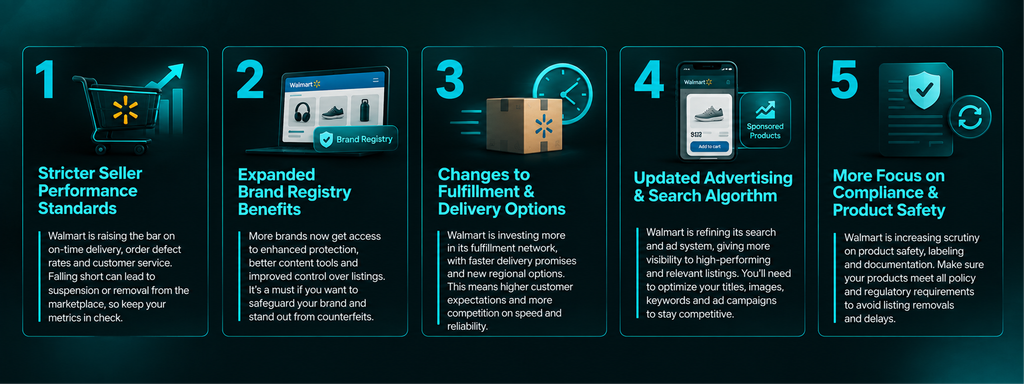
Taken individually, these are housekeeping updates. Read together, they describe a platform tightening its operational layer: authentication, account integrity, fulfillment accuracy, and catalog tooling all moving in the same direction at once.
That is what a marketplace does when it is scaling seriously, and Walmart Marketplace is scaling faster than most. The platform has been growing quickly, adding sellers at a pace that makes marketplace integrity a genuine priority rather than a policy page. The company has been public about that direction, laying out seller tooling and integrity initiatives at its annual Marketplace Seller Summit, and trade coverage has tracked the same pattern of AI seller tools and in-store marketplace visibility arriving alongside stricter operational standards.
For Walmart sellers, that direction cuts two ways. Operators who keep integrations current, catalogs clean, and fulfillment accurate get a platform that works predictably underneath them, on a Walmart Marketplace still open enough to reward early movers. Operators running on drift get caught by deadlines exactly like the one closing this month.
Build the habit that catches the next one
The specific changes matter less than the process for catching them. Every one of the Walmart sellers reading this will face another deadline within months, and the outcome depends entirely on whether anyone is watching.
Three practices make the difference.
Schedule a monthly release-note review. Fifteen minutes on Walmart’s Seller Center release notes each month catches changes while they are routine rather than urgent. Put it on a recurring calendar entry with a named owner, because a task belonging to everyone belongs to nobody.
Keep an integration inventory. A simple list of every tool with access to your Walmart Marketplace account, who owns the relationship, and when it was last verified. Most Walmart sellers cannot produce this list on request, which is precisely why authentication changes cause damage.
Watch for silence, not just errors. The most expensive failures produce no error at all. If your inventory numbers have not changed in three days, that is not stability. Set a check for data that stops moving.
The Walmart sellers who stay ahead are the ones watching
None of these five changes is dramatic on its own. Together they remind Walmart sellers that a marketplace is infrastructure you are building on, and infrastructure changes underneath you whether or not you are paying attention.
At Treszon, we track platform changes as they land and act before deadlines rather than after, because we operate every brand we run like we own it. That is the whole of our Walmart marketplace services approach: keep the Walmart Marketplace operational layer current so growth work is not constantly interrupted by something that broke quietly last week.
If you would rather have a team watching this for you, that is a conversation worth having.
Platform changes are only disruptive to the people who find out late.
Frequently asked questions
What happens if I miss the Delegated Access deadline?
Integrations still using the old method stop working at the end of September 2026. There is no error state on your end, so the practical symptom is data that stops updating. Reauthorizing through the Walmart App Store restores the connection.
How do I know which Walmart Marketplace tools need reauthorizing?
Check the connected applications in your Walmart Seller Center account and contact each provider. Any provider that has not communicated about the OAuth 2.0 migration is worth chasing directly.
Does the extended return window apply to every category?
No. Exclusions include wireless phones, protection plans, major appliances, food and beverages, and select seasonal and luxury goods. Check the current policy for your specific categories.
Is multi-box fulfillment available through Ship with Walmart?
Not currently. It is supported through Seller Center, bulk Excel upload, and the API.
Where does Walmart Marketplace publish these changes?
Platform and policy updates appear in the Seller Center release notes, and API changes appear on the developer portal. Both are worth checking monthly, and both are free for Walmart sellers to read.