
Artificial intelligence has crossed a line. For years, AI answered questions and generated content on request. Now it can set a goal, build a plan, use tools, and finish the job on its own. That shift is the single most important development in enterprise technology right now, and it is why every leadership team is scrambling to understand it. The numbers show why the urgency is real. Gartner predicts that 40 percent of enterprise applications will feature task-specific AI agents by the end of 2026, up from less than 5 percent in 2025.
This guide explains the agentic AI meaning in plain language, shows how the technology actually works under the hood, walks through the seven ways it is already transforming business operations, and covers what it takes to deploy it without joining the projects that fail.
Agentic AI Meaning: What It Actually Is
The simplest agentic AI definition is this: an artificial intelligence system that can pursue a goal with minimal human supervision. Where a chatbot passively responds to prompts, agentic AI acts. It breaks a complex objective into smaller steps, uses external tools like APIs, databases, and web browsers, executes each step, and self-corrects until the task is finished.
That is the essence of the agentic AI meaning, the move from answering to doing. A generative model can write a marketing email. Agentic AI can research the audience, write the email, send it, measure the response, and improve the next campaign, all without waiting for a human to trigger each step. In technical terms, it is a subset of generative AI that uses large language models as a reasoning brain to take real actions in real systems.
It helps to separate three terms that often get blurred. Generative AI creates content. An AI agent is a single autonomous unit built to perform a specific task. Agentic AI is the broader, coordinated system that puts one or many agents to work toward a larger objective. Think of an AI agent as one tool in a toolbox, while the wider approach is the coordinated use of those tools to build an entire house. That distinction matters because the real enterprise value, as we will see, comes from agents working together rather than in isolation.
How Agentic AI Works: The Five-Stage Loop
Behind every agentic AI system runs a continuous loop of five stages. Understanding this loop is the key to grasping why agentic AI can handle work that rigid automation cannot.
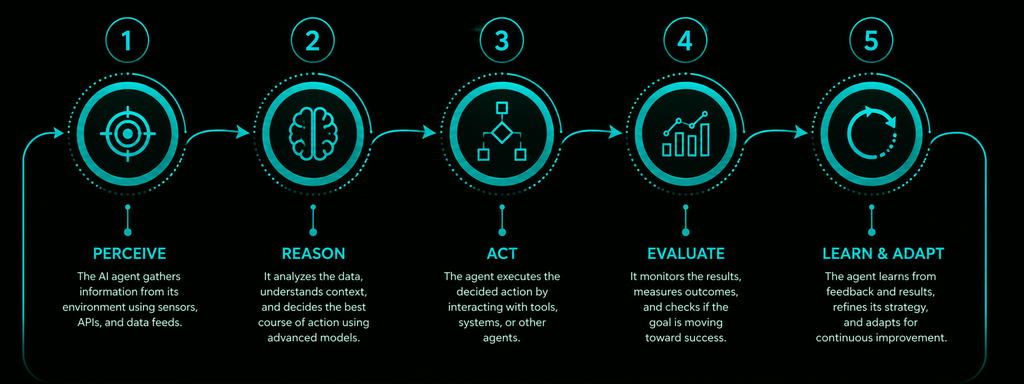
Perception. The agent gathers information from its environment, whether that is documents, databases, sensors, or direct user input, and interprets the situation. This could mean reading a support ticket, parsing an invoice, or pulling live data from an API.
Reasoning. Using a large language model, the agent analyzes the gathered data, identifies what is relevant, understands the context, and formulates possible solutions. This is where the system decides what actually needs to happen.
Planning. The agent sets a goal, breaks it into a sequence of smaller steps, and works out the most effective path to reach it. Unlike a fixed script, this plan can change as new information arrives.
Action. The agent executes the plan, calling tools, updating records, sending messages, and making decisions along the way. This is the step that separates agentic systems from every AI that came before, they do the work, not just describe it.
Reflection. After acting, the agent reviews the outcome, evaluates whether it succeeded, and uses that feedback to improve next time. This closing loop is what lets agentic AI get better the longer it runs.
Developers build these systems using agentic AI frameworks such as LangGraph, CrewAI, and AutoGen, which let multiple specialized agents collaborate, delegate tasks, and share context with one another. (This is exactly the kind of system our AI agents are built on.) That work increasingly runs on dedicated agentic AI platforms that handle model training, deployment, monitoring, and governance across the entire lifecycle. For complex business processes, several agents operate in sync under one coordinating model, an architecture that analysts widely expect to become the standard in 2026. This is often described as a multi-agent system, and it is where single-purpose tools give way to networks of agents that run whole workflows end to end.
Agentic AI vs Generative AI: The Key Difference
The two technologies are related, and they are frequently used together, but they are not the same thing. Generative AI is focused on creation. Give it a prompt, and it produces new text, images, code, or music. Its value comes from what the underlying model can generate, plus simple extensions like chaining outputs together.
Agentic AI is focused on orchestration and execution. It uses generative models as one of its tools, but it goes further by taking actions in real systems to achieve higher-level goals. A useful way to picture it: generative AI could write your marketing materials, while agentic AI would then deploy those materials, track how they perform, and automatically adjust the strategy based on the results. In that sense, generative AI is a capability the agent calls on, and the agent is the operator that turns capability into outcome.
7 Powerful Ways Agentic AI Benefits Business
The value of agentic AI here is not theoretical, and the momentum is not hype. Gartner also predicts that at least 15 percent of day-to-day work decisions will be made autonomously through agentic AI by 2028, up from zero percent in 2024. Here is where that shift is already showing up across the business.
- Customer support automation.
Agents read incoming messages, understand the issue, pull relevant data from your CRM and knowledge base, and either resolve the query or route it to the right person, all in seconds.
Agentic AI lets support teams stop drowning in repetitive tickets and focus on the cases that genuinely need human judgment. The trajectory is steep: Gartner projects that by 2029, autonomous agents will resolve the majority of common customer service issues without human intervention.
- Sales pipeline management.
Agents monitor your CRM, track deal stages, send follow-up messages at the right moment, update records automatically, and flag deals at risk of going cold.
With agentic AI handling the admin, your sales team spends its time closing. McKinsey research links this kind of AI-driven optimization to double-digit gains in sales productivity and ROI.
- Finance and invoice processing.
Agents extract data from incoming invoices, match them against purchase orders, flag discrepancies, route approvals to the right stakeholders, and update the accounting system.
With agentic AI, work that once took a finance team days now runs in hours with near-zero error rates, and the audit trail is cleaner than manual processing ever produced.
- HR and recruitment automation.
Agents scan incoming applications, score candidates against your job criteria, send screening questions, schedule interviews, and keep applicants updated throughout the process.
HR teams cut time-to-hire sharply and spend their energy on final-stage decisions rather than administrative churn.
- Supply chain and inventory management.
Agents monitor inventory levels, track supplier performance, detect potential shortages before they happen, and trigger reorder workflows automatically.
When a disruption hits, the agent evaluates alternative suppliers, weighs cost against lead time, and recommends the best path forward without waiting for a manager to notice the problem.
- Marketing campaign execution.
Agents build audience segments, generate ad copy variations, launch campaigns across multiple channels, monitor performance in real time, and reallocate budget toward the best-performing ads on their own.
With agentic AI, marketing teams move from spending weeks on campaign setup to focusing entirely on strategy and creative direction.
- Autonomous decisions at scale.
Because agents run around the clock and improve over time, businesses can handle far more work without adding headcount. Independent productivity research points to knowledge workers recovering several hours per week once production agents take over routine tasks.
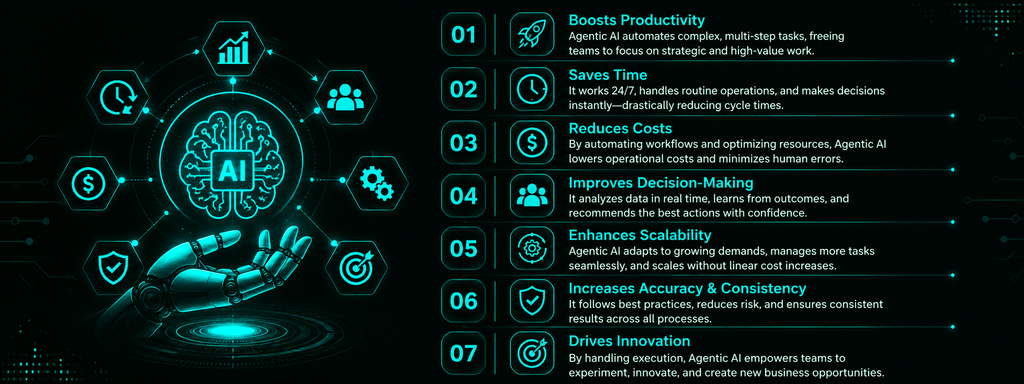
That compounding leverage is the whole point of AI workflow automation, which replaces brittle, rule-based processes with agents that adapt, handle exceptions, and run end to end. That compounding leverage is why Deloitte expects as many as 75 percent of companies to invest in agentic AI in 2026.
The Numbers Behind the Shift
A few well-sourced figures make the scale of the agentic AI transition concrete. Adoption has already moved from curiosity to standard practice: McKinsey’s State of AI research found that 88 percent of organizations now use AI in at least one business function, with 23 percent already scaling an agentic system in at least one area. The economic prize is enormous. McKinsey estimates that AI agents could add between 2.6 and 4.4 trillion dollars in value annually across business use cases.
But the same research that shows opportunity also shows discipline is required. Returns are real yet uneven, they vary by use case, data maturity, workflow design, and scale, which is exactly why a thoughtful rollout matters more than raw enthusiasm. The organizations pulling ahead are not the ones deploying the most agents. They are the ones deploying the right agents on the right problems.
Real Problems, Real Results
To see the difference agentic AI makes, it helps to look at concrete patterns rather than abstractions. In customer service, a retailer can replace a basic chatbot that only answers scripted questions with an agent trained on the full product catalog.
That agent asks clarifying questions, retrieves precise answers, cites its sources, and guides a buyer to the right product in fewer steps, running continuously without human staffing overnight. This is where modern AI chatbots move well beyond scripted bots into agents that actually take action.
In operations-heavy fields like appointment booking or slot monitoring, an autonomous agent can watch a website around the clock, react within seconds when something changes, and alert the right person instantly, work that would otherwise consume hours of manual refreshing every day.
In knowledge work such as market research or report generation, agentic AI can automate data collection, validate assumptions, and produce a structured output in minutes instead of the hours a manual process demands. The common thread is that each agent is pointed at a specific, well-defined business problem, integrated with real data, and measured on a real outcome.
Considerations and Best Practices for Deployment
None of this agentic AI value is automatic. In fact, Gartner warns that more than 40 percent of agentic AI projects could be canceled by the end of 2027, largely because of unclear value, escalating costs, or weak governance. Avoiding that fate comes down to a handful of fundamentals.
Start with clear objectives. Identify the specific problems an agent will solve and how they map to business goals, then pursue agentic AI only where it delivers measurable ROI. Chasing novelty is the fastest route to a canceled project.
Get your data right. Agentic AI relies on high-quality, well-integrated data to make accurate decisions. Information that is incomplete, out of date, or poorly formatted will produce unreliable agents no matter how capable the underlying model is.
Build in governance and oversight. Enterprise agentic AI deployment demands accountability, real-time monitoring, audit trails, explainability, and human-in-the-loop controls that keep agents operating within defined boundaries and in compliance with regulations. Explainability techniques help teams understand why an agent made a decision, which builds trust and makes debugging possible when something goes wrong.
Plan for integration and security. Connecting agentic AI to existing systems takes careful coordination, and agentic AI can be a target for cyberattacks, so robust security is not optional. Then monitor continuously and refine, treating the agentic AI deployment as a living system that improves rather than a one-time install.
The Bottom Line
Agentic AI is the difference between software that waits and software that works. The opportunity is genuine, the agentic AI adoption curve is steep, and the businesses moving now are building durable advantages while their competitors are still running manual workflows. But agentic AI rewards discipline over hype.
The winners will be the ones that Grasping the agentic AI meaning is step one. Acting on it, carefully and with a clear focus on outcomes, is what turns a fast-moving trend into a lasting competitive edge. This is where Treszon comes in. It helps you deploy the right agents, on the right problems, with the data quality, governance, and oversight to make them trustworthy at scale.