
Two major Amazon updates are rolling out in 2026, and both are being widely misread. One changes how the Featured Offer, still known to most as the Buy Box, gets awarded. The other quietly reshapes how your multipack listings are structured. Neither is as harmless as the popular interpretation suggests, and the Amazon sellers who act on the wrong reading are the ones most likely to lose ranking, sales, and Buy Box share.
Here is what actually changed in each of these Amazon updates, why the common take is wrong, and exactly what to do before the deadlines hit.
Amazon Update 1: Removed a Buy Box Gate, Not the Standards Behind It
Starting July 2026, Amazon is removing seller performance as an eligibility requirement for the Featured Offer. The change rolls out across all stores globally through the end of the year, and every existing offer gets pulled in automatically. Amazon sellers on every marketplace are affected, whether they opt in or not.
The common read on this update is that seller performance no longer matters, or that any offer can now win that button regardless of price, delivery speed, or complaint history. That reading is wrong, and acting on it is how Amazon sellers quietly lose the Buy Box.
What is actually changing is the structure of the process, not the criteria inside it.
How It Worked Before
Amazon previously ran this in two stages. First, a seller had to clear a performance-based eligibility check. Only sellers who passed that check entered the pool that then got ranked for price, delivery, and service quality. That first stage, the performance gate, is the part being removed. Of all the recent Amazon updates, this structural shift is the easiest to underestimate.
What Changes Now
This means the system moves from a gate-then-rank model to a rank-only model. The signals that used to sit in that second stage of qualification, your chargeback rate, order defect data, and Voice of the Customer complaints, do not disappear. They simply move from being a qualifying filter to being direct inputs inside the ranking formula, sitting alongside price, free shipping, and delivery promise in one combined calculation.
In other words, performance did not stop counting. That is the detail most Amazon sellers miss. It stopped being a separate pass or fail gate and became part of the same math that decides who wins. For Amazon sellers, that is a meaningful difference, because a smaller signal set now carries more direct weight in a single ranking pass.
What You Should Do
Keep watching your Featured Offer percentage in Business Reports exactly the way you always have. Nothing about that habit should change. What changes is the stakes underneath it. If price and delivery promise were your weak points, they matter even more now, because once the pre-filter is gone, everything competes in a single pass and there is no separate cutoff absorbing the pressure. This is one of those Amazon updates where the right response is not to relax, but to tighten the exact metrics Amazon sellers assume no longer count.
Amazon Update 2: Virtual Multipacks Are Not a Passive Addition
The second of these Amazon updates is quieter, and in some ways more dangerous, because it changes your catalog structure without asking. Amazon has started notifying sellers inside Seller Central about a new Virtual Multipack, or VMP, pilot.
Here is how it works. Eligible ASINs receive a VMP automatically, and it gets placed inside the same variation family as the existing single-pack ASIN. All VMPs are scheduled to be created by July 27, and they go live for customers on August 10.
The current read on this update treats it as a passive addition, a new buying option that simply sits next to an existing listing without touching anything underneath it. That is the assumption that catches catalog owners off guard, and it is why so many Amazon sellers will be reacting instead of planning.
Why a Variation Family Changes Everything
Variation families operate as one shared structure. Adding a child ASIN to a family redistributes traffic, review weight, and Buy Box eligibility across every ASIN inside that family, including the ones that were already selling well on their own. A new VMP entering a variation family shifts the ranking and pricing signals for the entire group starting the moment it goes live, not just for the new listing itself.
So the VMP is not a bolt-on. It is a structural change to a system where every child ASIN affects every other child. For Amazon sellers with a carefully tuned catalog, that is exactly the kind of change worth getting ahead of. Amazon updates like this one reward the catalog owners who plan ahead.
What You Should Do
The useful move here is to act before the July 27 creation date rather than react after August 10. Amazon sellers should review every ASIN flagged for VMP creation. Decide with intention which variations should actually exist inside your catalog, rather than letting the pilot decide for you. Then use the Manage All Inventory page to edit or delete the ones that do not support your pricing or ranking strategy.
Catalog decisions made before August 10 carry far more control than reactions made after the listings are already live and already redistributing your performance data. Among recent Amazon updates, this is the one where the deadline genuinely matters, because once the redistribution starts, you are managing a moving system instead of setting it up on your own terms.
The Thread Connecting Both Amazon Updates
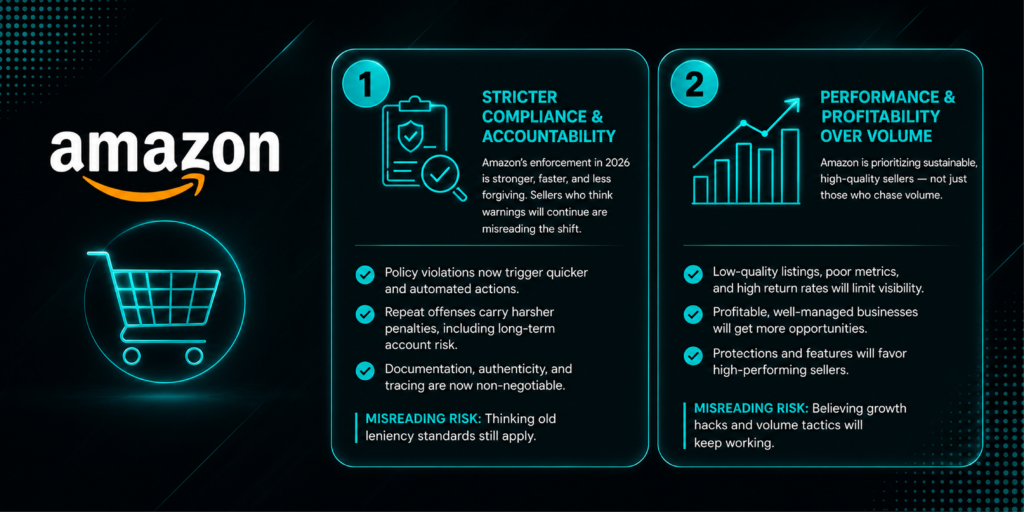
Read together, these two Amazon updates share a pattern worth internalizing. Both are being interpreted by busy Amazon sellers as nothing really changing, and in both cases that interpretation is backwards. The Buy Box change is read as performance no longer mattering, when performance actually became more directly weighted. The VMP change is read as a passive new listing, when it actually restructures how an entire variation family competes.
The lesson for Amazon sellers is the same in both cases. When Amazon simplifies or automates something, it is usually changing where the pressure lands, not removing it. The Amazon sellers who win through these transitions are the ones who read the mechanics carefully instead of the headline, and who move before the deadline rather than after it.
Get Ahead of These Amazon Updates With Treszon
Both of these Amazon updates reward the Amazon sellers who prepare and punish the ones who assume. The Featured Offer change means your price, delivery promise, and performance metrics now compete in one pass with no gate to hide behind. The VMP pilot means your catalog structure is about to change on a deadline, and the smart decisions happen before August 10, not after.
At Treszon, this is exactly the work we do for the brands we manage. We monitor Amazon updates as they land, translate what they actually change beneath the surface, and take action on your account, from tightening the metrics that drive the Featured Offer to auditing your variation families and catalog before automated changes redistribute your hard-won performance. We help Amazon sellers stay ahead of the platform instead of scrambling to catch up with it, and we operate every brand we take on like we own it.
If you want these Amazon updates handled correctly, before they cost you ranking and sales, that gap is exactly what we close. Let’s talk.