
Your Amazon product listings can have a great product behind them and still get buried, or worse, suspended. Not because of the product, but because of the copy. Amazon enforces a strict set of rules on what you can and cannot put in your titles, bullets, descriptions, and backend fields, and breaking them quietly costs sellers rankings, revenue, and sometimes the entire listing.
Most sellers never read those rules in full. They copy a competitor, cram in keywords, add a few promotional phrases, and then wonder why their Amazon listings underperform or get flagged. This guide walks through the eight most common and most damaging mistakes, why each one hurts, and what to do instead. Fixing these is the foundation of every serious Amazon listing optimization effort, and skipping them is why so many otherwise good Amazon product listings never reach their potential. Clean Amazon listings are the baseline, and optimized Amazon product listings with best SEO practices are the goal.
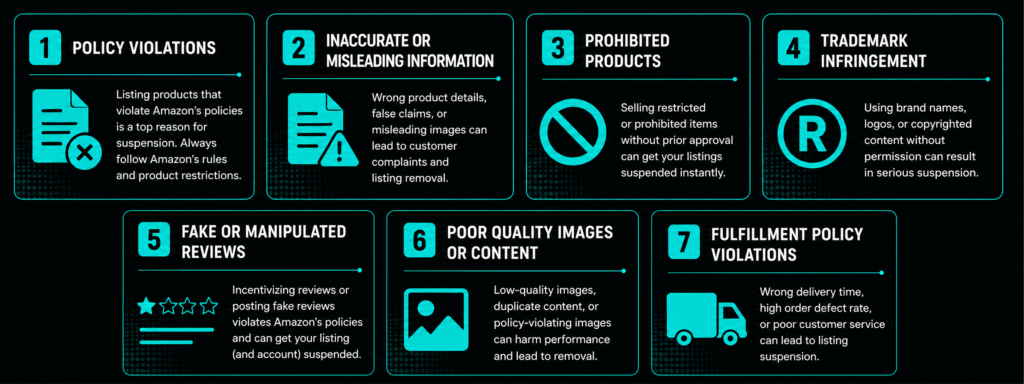
Mistakes in Your Listing Copy and Content
The words on your detail page are the first place Amazon looks, and the first place most Amazon listings go wrong. Fix these four and your Amazon product listings stop fighting the algorithm and start working with it. Four mistakes account for the majority of the damage.
1. Keyword Stuffing
Cramming repetitive or irrelevant search terms into your title or bullet points ruins readability and triggers ranking penalties. Sellers assume that repeating a keyword ten times signals relevance to Amazon. It does the opposite. Amazon’s search algorithm indexes a term once, and stuffing beyond that adds no ranking value while making the copy unreadable for the shopper who actually has to buy.
The fix is discipline. Use each important keyword once, place it where it matters most, and write for the human first. Clean, readable Amazon listings convert better and rank better than stuffed ones, which is the whole point of Amazon listing optimization done properly, and it is how strong Amazon listings earn rank instead of forcing it.
2. Promotional Language
Words like “free,” “sale,” “best,” “hot item,” or “20% off” are strictly prohibited in your product titles and descriptions. Amazon does not allow promotional or subjective claims in your Amazon product listings, because they are unverifiable and create an uneven playing field. Include them and Amazon will either strip them out or flag the listing for review.
Instead, sell on substance. Describe what the product is, what it does, and who it is for. Concrete features and benefits persuade shoppers and keep your Amazon product listings compliant at the same time.
3. HTML Tags and Special Characters
Do not use HTML tags like bold or italic markup, JavaScript, or unusual symbols in your text. Basic line break tags for spacing are the only exception Amazon tolerates. Everything else either fails to render, displays as raw code, or gets your listing flagged. Decorative symbols and emoji in titles are a common and avoidable trigger.
Keep your Amazon listings in clean plain text. If you need structure in your bullets or description, use line breaks and clear sentences rather than code. Clean formatting is a small detail that separates professional Amazon listings from amateur ones.
4. Unsubstantiated and Medical Claims
Avoid strong health or medical buzzwords such as “cures,” “treats,” “heals,” or “FDA approved.” These are among the fastest ways to earn an instant compliance suspension, because health claims are heavily regulated and Amazon enforces them aggressively. Even a well-meaning phrase like “relieves anxiety” or “boosts immunity” can pull a listing down.
Stick to factual, substantiated descriptions of what the product actually does. If a claim cannot be backed up, it does not belong on the page. This is one area where careful Amazon listing optimization is not just about ranking, it is about keeping your account alive. Compliant Amazon product listings never gamble the account on an unverified health claim.
Mistakes in Your Backend and Keywords of Amazon Product Listings
The parts of your Amazon listings that shoppers never see cause just as many suspensions as the parts they do. These four mistakes live in the backend and the fields around your copy.
5. Contact Info and External Links
Do not include phone numbers, email addresses, or links to your personal website or store anywhere in your listing text. Amazon prohibits any attempt to drive shoppers off the platform, and this rule is enforced strictly. A single email address in a bullet point can get Amazon listings suspended without warning.
Keep the entire transaction on Amazon. Your detail page exists to convert the shopper right there, not to route them somewhere else. Clean Amazon listings keep the shopper on Amazon, where the sale happens.
6. Reviews and Testimonials in the Description
Do not paste customer reviews, quotes, or testimonials directly into your product description. Amazon has a dedicated reviews section for social proof, and copy that you write yourself cannot be verified as genuine customer feedback. Pasting reviews into the description reads as manipulation and invites a takedown.
Let the reviews system do its job, and use your description to communicate features, use cases, and specifications. That division of labor keeps your Amazon product listings clean and trustworthy.
7. Duplicating Backend Search Terms
Once a keyword appears in your frontend title, bullet points, or brand field, do not duplicate it in the backend search terms. Amazon already indexes it, so repeating it in the backend wastes the limited character space you paid for and adds zero incremental reach.
Use the backend for the words your visible copy does not already contain: synonyms, alternate spellings, related terms, and use cases. Treating the backend as an extension of your frontend rather than a copy of it is one of the highest-leverage moves in Amazon listing optimization, and it is where a good Amazon listing optimization tool earns its keep by flagging duplicates automatically. That discipline keeps Amazon product listings lean and fully indexed.
8. Competitor Brand Names and Trademark Violations
Do not use competitor brand names in your listing text to capture their traffic. This is an intellectual property violation, and it is one of the most common reasons Amazon listings get suspended. Amazon and brand owners actively monitor for it, and the penalty is swift.
Build your visibility on your own terms, your own brand, and your own relevant keywords. Borrowing a competitor’s trademark is not a shortcut, it is a liability that puts every one of your Amazon product listings at risk.
Turning These Mistakes Into an Optimized Listing
Avoiding these eight mistakes is not the finish line, it is the starting line. Compliant copy keeps your Amazon listings alive, but real growth comes from pairing that compliance with genuine Amazon listing optimization: structured product data, keyword strategy grounded in real search demand, benefit-led bullets, and disciplined backend hygiene.
Doing that at scale is hard to manage by hand across a full catalog. This is where an Amazon listing optimization tool helps you audit titles, catch prohibited language, and surface keyword gaps, and where dedicated Amazon listing optimization services take the work off your plate entirely. The goal is the same either way: Amazon product listings that stay compliant, rank for the terms that matter, and convert the traffic they earn. Whether you use a tool or a partner, the outcome is Amazon product listings that convert and Amazon listings that last.
The sellers who win are not the ones cramming the most keywords or making the boldest claims. They are the ones whose Amazon listings are clean, compliant, and built to be trusted by both the algorithm and the shopper.
Where Treszon Comes In
Getting your Amazon product listings right is exactly what we do at Treszon. We build compliant, optimized Amazon listings that avoid every one of these mistakes, from keyword strategy and title structure to bullet copy, descriptions, and backend search terms. Our Amazon listing optimization services combine the technical discipline of a listing audit with the commercial strategy that actually moves rank and revenue, and we manage it across your whole catalog so nothing slips through.
We operate every brand we take on like we own it, which means we treat your listings as if our own revenue depended on them. If your Amazon product listings are underperforming, getting flagged, or simply not converting the way they should, that gap is exactly what we close. Let’s talk.